The Underwriting Criteria That Separate True Robot Fleet Inland Marine Specialists From Generalist Markets
Six underwriting tests show which insurers truly understand autonomous fleet risk.
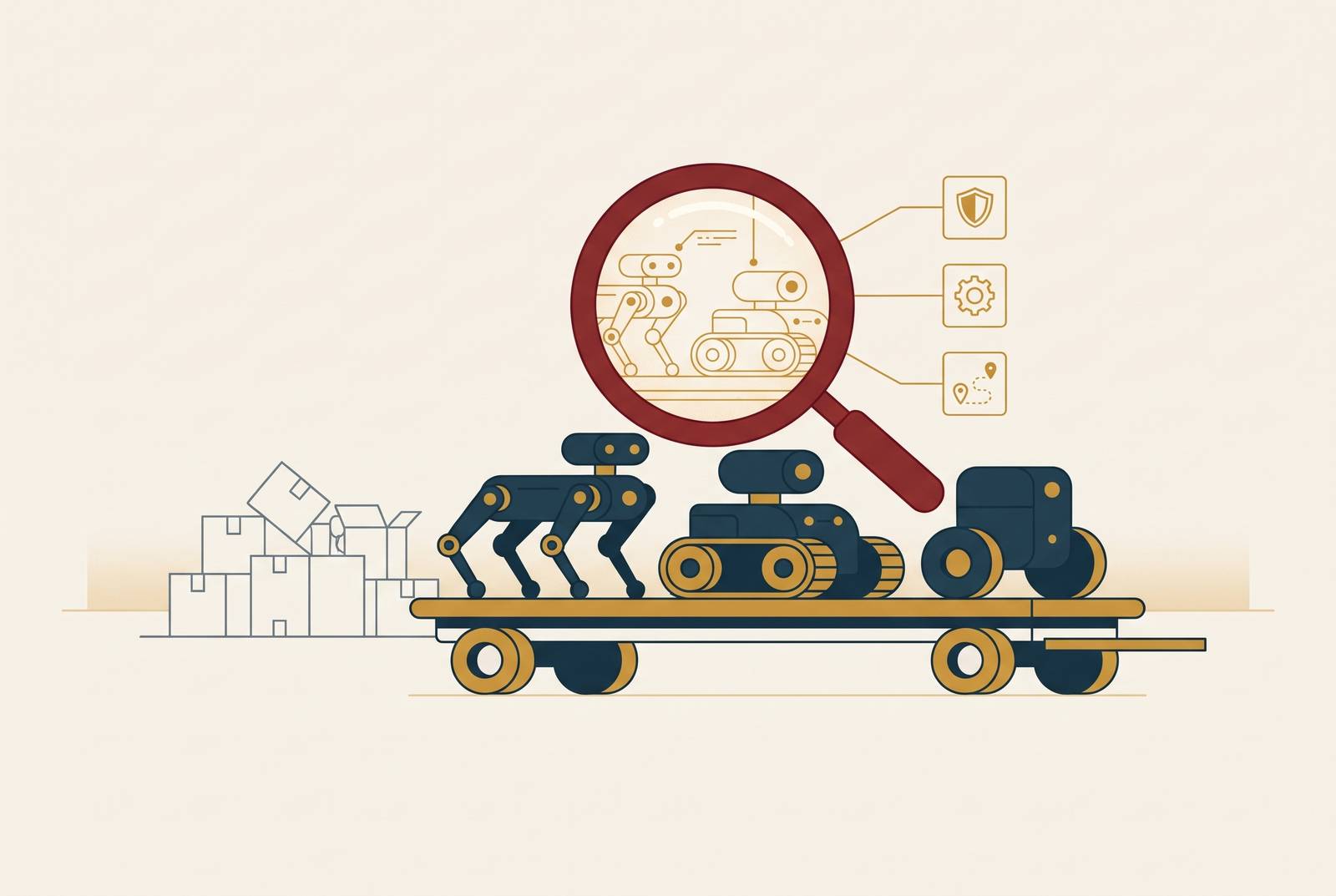
Inland marine coverage for deployed robot fleets follows equipment in transit, between job sites, and wherever it operates, but a standard form may not cover autonomy-related losses. True specialists distinguish themselves through replacement-cost valuation, operational evidence, remote oversight, cyber coordination, fleet accumulation analysis, and policy language written for autonomous failures. Those criteria let operators test coverage before a claim exposes its limits.
Why inland marine was never designed for autonomous fleets, and what that costs operators
Producing a certificate of insurance satisfies a site owner’s demand before a robot crosses the threshold. It does not establish whether the underlying policy can respond when the machine makes a decision that causes damage. Standard inland marine follows hardware away from a company’s premises, including while it is in transit, at jobsites, or in pilot deployments. Its language, however, was built around equipment with a human at the controls.
The loss may stem from an algorithmic decision, a sensor misread, an overnight software update, or a delayed remote command. Valuation methods, cause-of-loss definitions, and exclusions written for conventional equipment may not account for losses like these. Responsibility can also extend beyond one insured operating one machine to the manufacturer, software developer, systems integrator, and remote operations center. The risks go beyond the equipment damage that the certificate seems to cover.
How the generalist market’s response to autonomy risk has narrowed rather than adapted coverage
The generalist market’s dominant response to autonomy uncertainty has favored exclusion over more detailed underwriting. Some markets use absolute exclusions that rule out coverage under several policy lines, whatever the details of the loss. The policy can look complete until a claim turns on how the machine operated on its own. At that point, the exclusion governs the outcome.
This is not a shortage of purchased limits. An operator can buy the standard lines, meet contractual limits, and pay the premium while retaining the very exposure that defines its operations. Raising those limits does not repair an excluded cause of loss. Nor does the presence of several policies establish that any one of them will respond.
An endorsement may appear to solve that problem. But an autonomous-operations endorsement is only as credible as the underwriting behind it. A generalist offering amended language without examining valuation, operational controls, and shared fleet dependencies may be papering over risk it has not assessed. The useful distinction is therefore not whether a market offers an endorsement, but whether its questions show that it understands the exposure being endorsed.
What true inland marine specialists actually ask about an autonomous unit’s value — and why generalists get it wrong
An invoice records a purchase, while replacing an autonomous unit can require its proprietary software stack, trained perception models, calibration data, and integration work. Those parts of the unit’s value may not be available off the shelf. A generalist that schedules only the invoiced hardware may substantially understate the cost of restoring the unit.
A specialist examines how that value develops after deployment. Months of operational data and models refined against real-world edge cases can make a deployed robot worth more than factory-fresh hardware of the same specification. The valuation inquiry therefore includes what has been added to the machine’s capabilities and what would be required to replace it. Hardware specifications alone do not resolve that question.
Software commonality adds another dimension to the valuation. A defect discovered after an incident may require remediation across the fleet, at a cost greater than replacing the damaged unit. A specialist asks about that shared exposure rather than treating every scheduled value as independent. This identifies an exposure that a hardware-only valuation leaves out of the coverage discussion.
How specialists use operational data as an underwriting input — and what their data requirements reveal about their expertise
Replacement cost establishes what is at stake. Operational data establishes how a loss can be understood. The evidence trail comes from sensor-fusion outputs, algorithmic decision logs, remote-operator commands, and network-performance logs. A specialist asks about that trail before binding coverage. A one-page equipment schedule cannot show whether an incident will be reconstructable after the damaged unit stops functioning.
The German Insurance Association’s position paper on autonomous inland vessels states the importance of insurers receiving full access to high-quality, accurate operational data. It also calls for standards and regulations that help mitigate and assess the risks. That is a position on the evidence insurers need. Its relevance to robot fleets is the same underlying question of whether a future claim can be investigated fairly.
Log preservation makes that question concrete for the underwriter. Specialists ask whether records survive hardware failure, where they are stored, and who controls access. They also examine software testing, approval, staged deployment, and rollback governance so that the record can connect a unit’s behavior to its software version. Structured answers support a risk assessment that can be priced favorably. Missing answers can lead a specialist to decline or rate conservatively, even where a generalist would never have asked.
Remote oversight architecture as a coverage criterion — what specialists examine that generalists never ask about
The remote operations center is a distinct underwriting exposure. Its architecture affects both the likelihood of a fleet incident and the allocation of responsibility afterward. Specialists examine communication-link redundancy and latency guarantees because a transmitted instruction and a unit’s decision may be separated by network delay. The evidence must distinguish system failure from human intervention rather than treating remote supervision as proof of continuous control.
The International Group of P&I Clubs’ July 2026 announcement brings autonomous vessel liabilities into its pooling arrangements but sets a boundary for the work of a land-based remote operations center. Workplace injuries belong in employers’ liability, and public or occupiers’ liability addresses the relevant liabilities at the center. Property and business interruption cover address damage to the center and its IT infrastructure. These are not interchangeable with fleet coverage. The marine example illustrates why underwriting the machines does not settle the insurance needs of the people and infrastructure supervising them.
Specialists also examine the human limits of remote oversight. Their questions cover how many units one operator supervises, the operator’s training and certification, and the management of fatigue and shifts. Workload can be a proximate cause variable in an incident. The presence of these questions in an application or supplemental questionnaire gives operators a practical way to distinguish operational underwriting from equipment scheduling.
Cyber as a structural coverage requirement for robot fleets, not an optional add-on
A compromised control link can turn a productive machine into an uncontrolled liability. The fleet’s risk assessment needs to include spoofing, jamming, or hijacking because these risks go beyond a technology-company data exposure. The potential loss extends beyond damaged hardware. A takeover of a unit’s controls can produce bodily injury and damage to other property, requiring coordination with the program’s liability coverage.
The Group’s July 2026 announcement says malicious cyber risks are still covered under mutual P&I arrangements, as they have been in the past. It also encourages owners to engage closely with their Club and underwriters about their specific exposures and insurance needs. That position applies to mutual P&I and gives land-based robots no automatic cyber coverage. As autonomous operations rely more on digital systems, owners still need to check the coverage they have.
A separately purchased cyber policy does not settle the issue. Its triggers may address data events without coordinating with the inland marine policy’s treatment of physical damage. A cyberattack that damages a robot could consequently fall between the two forms. Specialists structure the relevant coverage together, while a generalist placement may leave that coordination to the buyer.
How specialist underwriters handle fleet accumulation — the multi-unit risk that generic forms cannot price
Fleet accumulation changes the unit of analysis from one machine to all machines exposed to a common failure. Losses at different locations can be linked by software, a remote operations center, or communication infrastructure that the units share. Physical separation does not make those units independent. A specialist maps those dependencies and assesses what their simultaneous failure could cost.
An update that introduces a failure mode across the fleet is not simply an isolated equipment incident repeated by chance. It creates a common-cause event, and how the policy covers it depends on aggregate limits, accumulation caps, and the policy’s wording. A schedule with per-unit sub-limits may cover one unit’s loss while leaving too little coverage for other units hit by the same event.
Specialists use accumulation disclosures much as reinsurers use catastrophe aggregation analysis for conventional property risks. Specialists examine which assets share a loss mechanism and how much exposure that mechanism concentrates. Staged rollouts, rollback capability, and testing protocols influence the probability of a fleet-wide event, so they inform the underwriting as well as operations. Generic individual-unit pricing cannot capture that correlation. Even when every robot has been carefully valued, the policy still needs to account for what the robots depend on together.
What specialist policy forms contain that generic forms exclude — the language test operators can apply before a claim
For operators, the practical test is to ask the broker to show the specific language responding to a software-caused loss on a remotely operated unit. Marketing descriptions are not a substitute for that language. The answer should identify the relevant coverage grant, cause-of-loss definition, and exclusions. If the broker cannot point to them, the form has not demonstrated that it was written for the exposure.
Specialist forms cover the kinds of failure that autonomous systems have. Across the fleet program, those include bodily injury and property damage from navigation or perception failures, physical damage following a cyber takeover, and production losses from software updates or sensor failures. They also address situations in which a third-party sensor defect causes failure but the claim lands on the integrator. These responses belong in the appropriate policy lines rather than being assumed to arise from inland marine alone.
Broad AI or unmanned-operations exclusions can remove the protection that an operator expects from otherwise expansive physical-damage language. Affirmative coverage for autonomous failure modes makes clear how the policy is meant to cover those losses. A broad damage trigger alone does not resolve how a software-related loss interacts with the rest of the form.
The IMO MASS Code shows how coverage conditions can be tailored for marine risks. Adopted in May 2026 and in effect from July 1, 2026, it is the first global non-mandatory regulatory framework for autonomous vessel operation. Specialist marine underwriters reference compliance with that framework as a coverage condition. Such specificity depends on accurate underwriting. In turn, the underwriting depends on the submission that describes the operation.
How submission quality determines which specialist market a fleet operator actually reaches — and what a complete submission covers
Identifying a specialist market does not guarantee a quote. The submission must give its underwriters enough information to evaluate the fleet on specialist terms. That work is closer to technology due diligence than conventional equipment scheduling. The underwriter’s assessment of remote operations, software governance, evidence preservation, and shared infrastructure goes beyond applying a rate to asset values.
A complete submission sets out the fleet’s autonomy level and where and how it works, with a diagram of the remote-operations architecture that shows its failure modes. It includes records of tests on sensors and collision-avoidance software, qualifications and workload standards for remote operators, and protocols for preserving incident logs. Communication-link redundancy and latency specifications explain the control connection. Software version-control documentation, the regulatory and classification approval basis, and a cyber-security assessment of the control link establish further grounds for evaluation. Accumulation disclosure then shows how shared operations centers, software versions, and communication infrastructure put the whole fleet at risk.
The quality of that record affects pricing and capacity. A submission with missing details can suggest that risks are poorly managed and stop a specialist from giving a quote at all. A generic inland marine submission instead routes the risk toward conventional equipment pricing, without the operational detail needed to assess autonomy. A specialist broker’s contribution is to translate those details into underwriting evidence.