Inland Marine vs General Liability for Field-Deployed Robot Fleets
Inland marine insures the robot while general liability insures everyone it might hurt.
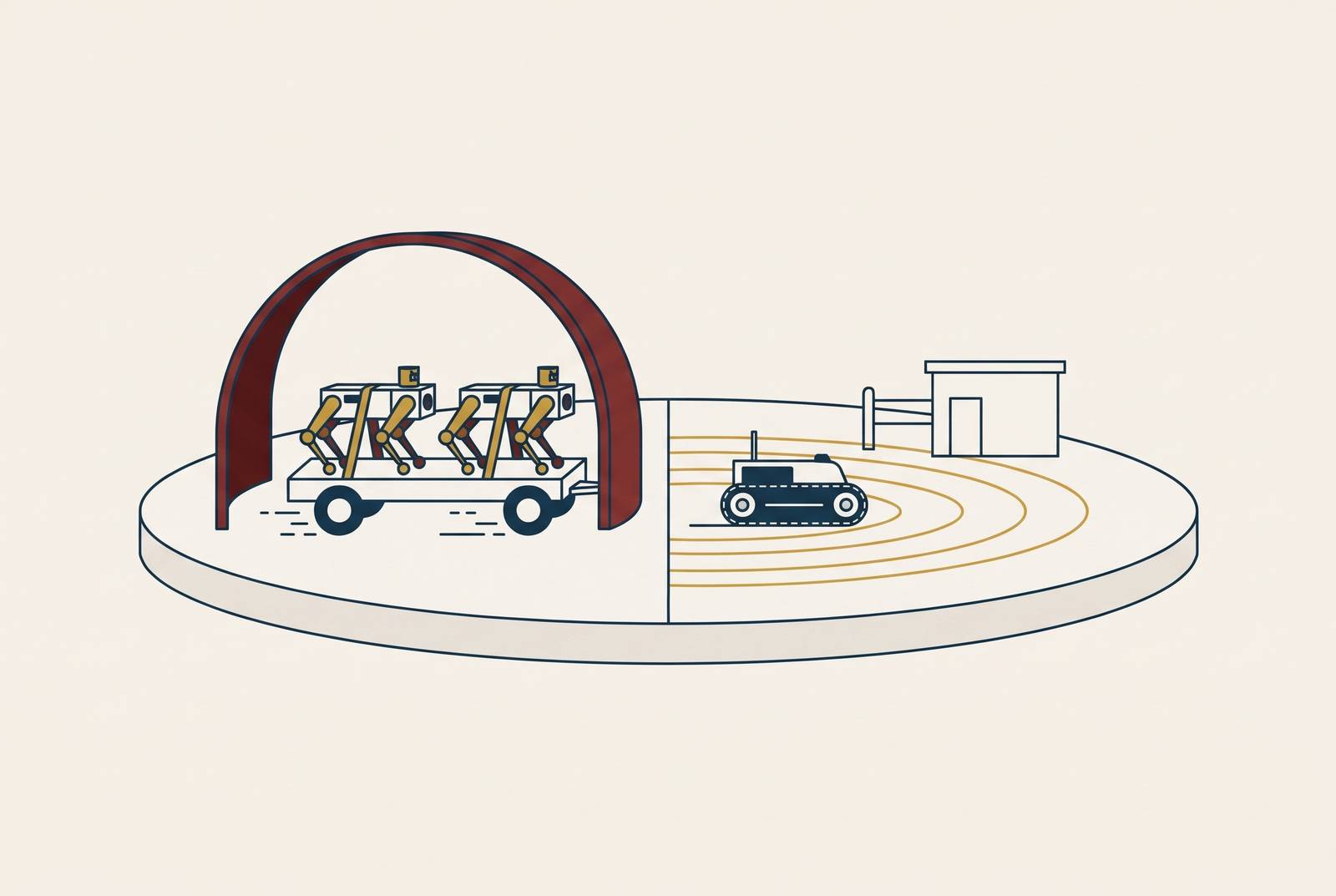
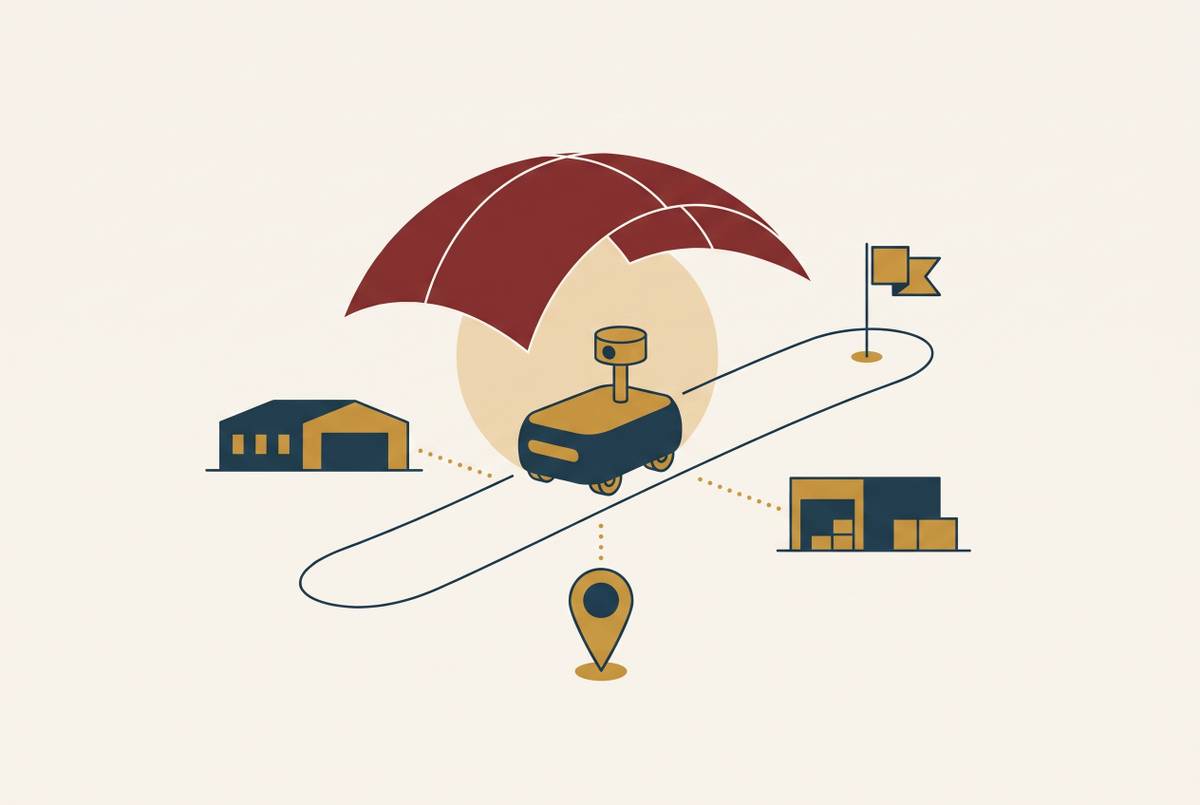
Inland marine coverage for deployed robot fleets protects the machines in transit, at customer sites, and during pilots and demos, subject to the policy’s terms. General liability covers third-party bodily injury and property damage caused by the machines. A working coverage program needs both, with forms and underwriting submissions that describe the fleet’s actual autonomous operations.
Why a robot fleet cannot be covered by a single policy
A robot leaving the lab crosses an insurance boundary as well as a physical one. Inside the building, the machine is on the premises that standard commercial property coverage is written to cover. Outside, it can be crushed in transit, stolen, or damaged at a customer site. It can also injure a bystander or damage a customer’s racking. Both exposures start before the deployment has shown its worth to the business.
One reduces the value of an asset the robotics company owns, while the other creates a claim against the company for harm to someone else. The distinction determines which policy can respond. Standard commercial policies were built for fixed premises and human-operated systems, and autonomous field hardware falls outside those assumptions from the start.
Confusing the two produces a practical failure. A company may buy liability insurance because a customer requires it and think its equipment is covered, or insure its hardware without buying coverage for third-party claims. Neither policy substitutes for the missing line. The company either bears an uninsured loss or directs a claim to a policy that was never designed to pay it.
What insurance covers autonomous robots traveling between job sites, and what does it exclude?
Inland marine is property coverage that follows equipment away from the insured premises. Its name comes from cargo insurance, but today it covers the kinds of work that mobile robots do. Coverage extends to equipment in transit, at jobsites, and on pilots and demos.
Coverage is typically written through an equipment schedule, with each unit listed at its replacement cost, giving the underwriter a defined set of assets and values. A crated robot traveling to a customer can represent months of build time, making the journey itself a substantial property risk.
The policy’s exclusions define where that protection stops. Wear and tear and mechanical or electrical breakdown are excluded, with internal failures belonging to equipment breakdown coverage. Third-party bodily injury and property damage caused by the equipment belong to general liability. The floater pays to repair or replace covered equipment, leaving income lost while a unit is down uninsured. Highway-registered vehicles fall under commercial auto.
What general liability actually covers, and where it draws its own line
General liability responds to claims for harm caused to other people and their property. For a deployed robot, that can mean bodily injury to a bystander or damage to a customer’s facility. The insured machine is not the protected asset.
That function also establishes the policy’s limits. General liability does not pay to replace the robot itself or cover injuries to the company’s own employees, which fall under workers’ compensation. Nor does it cover money lost when a robot goes offline without physically harming a third party.
General liability also has an immediate commercial role. Site owners and enterprise customers require proof of coverage before a robot enters their facilities, typically with a substantial minimum limit per occurrence. The company therefore needs more than an internal judgment that its machine is safe enough to deploy. It needs the required certificate before it can enter the site.
How the two policies divide responsibility across a single robot incident
Consider a robot operating in a customer warehouse when a forklift strikes it. The unit is destroyed, and a worker standing nearby is injured in the collision. The hardware loss belongs on the inland marine track. A third-party bodily injury claim against the robotics company belongs on the general liability track, subject to the policy’s terms and the liability facts. One collision creates two distinct insurance questions.
Removing either policy exposes a different part of the loss. Without inland marine, the company absorbs the robot’s replacement cost. Without general liability, it faces the third-party injury claim without that protection and cannot provide the site owner with the required evidence of coverage. Having both lines allows the event to be addressed without confusing the damaged asset with the injured person.
Autonomy can complicate who is responsible for the injury. If navigation or perception causes an incident, the claim may reach the hardware maker, software developer, or operator, with disputes across all three. That liability chain makes an accurate description of the operation essential to underwriting.
Where standard property and liability forms break down for autonomous systems
Two policy categories do not guarantee suitable coverage. Standard property coverage is tied to described premises, so most such coverage stops following a unit when it leaves for a pilot. An inland marine floater closes that location gap only when it is in place and the equipment is scheduled at the right value.
The liability side has a separate problem. AI exclusions in standard commercial filings can remove protection for the very activity that makes a robot autonomous. When major carriers asked state regulators for approval to exclude AI-related damages from general liability policies, 80% of those requests were approved. Some carriers have also added absolute AI exclusions across multiple lines.
A software update can take a robot offline without damaging the machine or physically harming a third party. In that case, lost production is an economic loss outside the conventional coverage triggers of standard inland marine and general liability. Raising the insured hardware value or the liability limit alone will not cover this loss.
Axis Insurance built a robot-specific program for companies that make and deploy autonomous robots that addresses this exposure explicitly. The program covers production losses from a software update or sensor failure that takes a robot offline even without physical damage. It also covers bodily injury or property damage from AI navigation or perception failures.
How the deployment context changes what each policy needs to cover
In a fenced industrial cell, bodily injury exposure is lower, so equipment value and production loss lead the analysis. An open warehouse aisle changes that balance. AGV-style robots work near racking, products, and forklift operators, so both liability and equipment coverage need to account for how close they are to workers and existing infrastructure.
Public deployment changes the analysis again. Sidewalk and outdoor operations add pedestrians, cyclists, and municipal permit requirements, with the highest bodily injury exposure and closer scrutiny of general liability limits. Agricultural and construction field work creates a different equipment problem. Heavy robots may operate unfenced and far from a technician, making unit values and documentation of the operating envelope central to the inland marine underwrite.
A larger fleet with high replacement costs presents a different property exposure from a small deployment. Enterprise customers can also require umbrella limits above primary general liability in their master service agreements. The locations, operating conditions, fleet values, and contractual requirements all shape what it needs to cover.
Bot Auto’s autonomous freight insurance program illustrates this multi-line structure. It includes auto liability, property, general liability, cargo and inland marine protection, and a separate cyber policy. Those categories show the breadth of the program without establishing its detailed policy terms. Bot Auto’s announcement also notes that qualification for Marsh’s AV insurance program requires a comprehensive risk mitigation approach beyond standard industry practices, as described by Marsh Managing Director Owen Oakley.
Why submission quality determines whether the policies you buy actually respond
The underwriting submission connects the actual deployment to the coverage offered. A vague or inaccurate account can produce exclusions that leave the operation unprotected when a claim arrives. Generic commercial applications leave underwriters without fields for supervision ratios, operating envelopes, geofencing logic, emergency stops, and safety case documentation needed to distinguish the robot from conventional equipment.
For inland marine, the critical inputs are each unit’s replacement cost and documentation of where and how the equipment travels. An outdated schedule may undervalue existing machines or omit hardware that has recently entered service. Either defect leaves part of the fleet uninsured. A policy intended to follow mobile equipment still depends on a current description of the equipment it is supposed to follow.
General liability underwriting requires a different set of evidence. Underwriters increasingly want telemetry, actuator certificates, incident reconstruction capability, and documentation of deterministic safeguards. Without that material, premiums may be higher or coverage more restricted. These details give the submission substance beyond a general claim that the robot operates safely. They also describe the autonomous exposure that a conventional application leaves unexplained.
AI exclusions make that description especially consequential. A generic submission gives an underwriter reason to apply a broad exclusion. By contrast, a submission built around machines in the field, presented to underwriters seeking machine risk, can produce materially different terms on both lines.
Building a coverage program that actually follows the fleet
Build the program in deployment order, starting with the coverage required to enter the customer’s site. General liability comes first because site owners require coverage for third-party bodily injury and property damage before they let robots onto the site. Inland marine follows at the first departure from the building, with each unit scheduled at replacement cost.
Workers’ compensation addresses the technicians who travel with the machines. It is legally required in most states once employees are on payroll, and field work increases claim likelihood compared with desk work. Tech E&O joins when the company licenses the autonomy stack, including a perception model, navigation service, or control policy, to customers. It addresses financial losses from failures in that software layer. Umbrella coverage adds limits above primary policies when enterprise agreements or site owners require them.
The program then needs to change with the fleet. Inland marine schedules and general liability limits should be revisited as unit values change, deployments expand, and new operating contexts are added. A policy arranged at formation can drift away from the business it was meant to protect. A growing fleet therefore needs coverage review as well as additional insured equipment.
The recommended route is a broker who reads the policies before they bind and places the submission with carriers that explicitly cover autonomous operations. The application should describe how the machines actually work rather than force the deployment into a generic conventional-equipment form. Before binding, the decisive question is whether the policy language matches the machines, movements, operating conditions, and claims the fleet can generate.