How SBIR Commercialization Changes the Inland Marine Equation for Autonomous Robot Fleets
How moving from SBIR prototype to production fleet exposes insurance gaps.
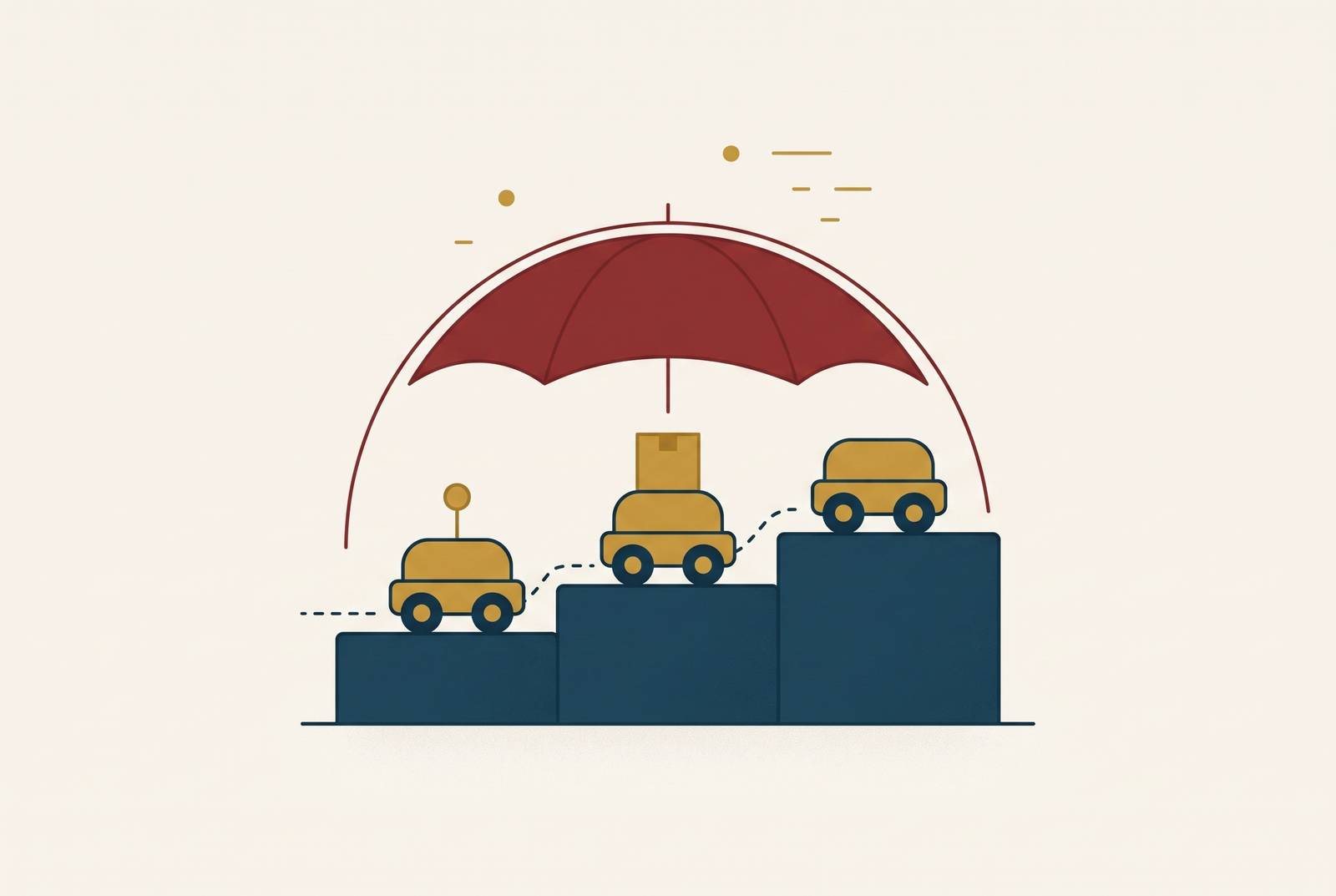
Inland marine coverage for deployed robot fleets covers the physical equipment as robots travel between job sites and work across multiple locations, but the fleet also needs other insurance. SBIR Phase III commercialization exposes gaps in standard forms because production changes fleet aggregation, operating conditions, liability, and valuation together. Protecting that fleet requires coordinated inland marine, tech E&O, cyber, and general liability coverage, supported by underwriting evidence that describes the autonomous system.
What SBIR Phase III actually is and why it moves robots out of the prototype category
SBIR Phase III gives any federal agency sole-source contracting authority to award a production contract to an SBIR firm without open competition, paid for from agency procurement budgets separate from SBIR set-aside funds. Phase I establishes technical feasibility, while Phase II builds and validates a prototype. Phase III takes that development work into production for use in the field under a procurement contract. The transition changes the company’s obligation from demonstrating a technology to delivering it for operational use.
Phase III was not legally blocked during SBIR program lapses because its funding came from agency procurement budgets. Production contracts continued, although new awards slowed. A small robotics company can therefore move from a funded bench prototype to a sole-source fleet-delivery contract faster than insurers have underwritten the category of equipment it is deploying.
STRATOM’s SBIR portfolio illustrates how production readiness develops before that crossing. The company progressed from early Phase I work through a Phase II Autonomous Pallet Loader program for the Marine Corps, reaching TRL 6. The vehicle was designed to move thousands of pounds of munitions, fuel, and water per trip in austere environments. Commercialization was part of the development work itself. Commercialization planning and manufacturing readiness were explicitly scoped into the Phase II deliverables, connecting prototype validation to the ability to produce equipment for deployment.
What inland marine was designed to cover and why autonomous robot fleets sit outside those assumptions
Inland marine is a natural starting point for mobile robots because it was designed for property in motion and specialized equipment in non-standard locations. But mobility is only part of the exposure. Traditional forms assume that equipment has replacement values that stay fairly steady, loss modes that can be predicted, and claims histories from conventional machinery. Those assumptions describe deterministic machines more readily than systems that decide how to act as conditions change.
Autonomous equipment disrupts the relationship between the insured object and its value. A robot’s replacement value can depend on proprietary software and trained models that have no independent market price. Its loss modes also extend beyond conventional machinery failures to sensor degradation, AI misclassification, and emergent fleet behaviors. Historical claims data tell underwriters little about those events. As manufacturing deploys more advanced automation, robotics, and precision instrumentation, high replacement costs are increasingly attached to equipment whose operation differs from the machines contemplated by the forms.
Inland waterway automation exposes the same uncertainty about control and causation. IUMI’s March 2026 discussion of autonomous inland vessels identifies enhanced data, contractual clarity, and clear underwriting assumptions as requirements for assessing the risk, rather than treating autonomy as grounds for automatic refusal. How the underlying private law framework applies and what it means for liability are still largely untested. For land-based fleets, the corresponding uncertainties concern who is legally operating a remotely controlled or autonomous machine, how causation is established when system failure and human intervention intertwine, and whether remote operation increases cyber aggregation risk. A description of the property alone cannot answer those questions.
The specific ways a Phase III production contract changes the risk profile an underwriter sees
Quantity is the first change an underwriter must assess. A prototype program might involve one or two units under controlled conditions, while a production award delivers a fleet into field operations. The resulting exposure is not simply more equipment at risk. A single compromised software update or sensor firmware push can take the whole fleet offline at once. Standard equipment scheduling does not, by itself, address that shared failure mode or establish how fleet aggregation is treated under the policy.
The operating environment changes at the same time. Test environments have controlled parameters, whereas production fleets may encounter austere terrain, contested environments, public roads, or active logistics corridors. STRATOM’s pallet loader targets include austere flight lines, expeditionary advanced bases, and Forward Arming and Refueling Points. Its Phase II work included advanced autonomy for austere terrain, adverse weather, and negative-obstacle avoidance. Underwriters need to treat the operating envelope in those conditions as central to the risk, with more weight than a minor detail alongside the equipment’s description and location.
The liability chain becomes more fragmented as deployment expands. A single robot incident can generate claims against the hardware manufacturer, software developer, and fleet operator, none of which can be addressed in full by an inland marine property form. A Phase III award may involve additional-insured requirements or applicable indemnification obligations, but neither should be assumed to apply uniformly across Phase III contracts. FAR insurance provisions and agency-specific requirements must be kept separate from obligations that apply to particular types of work.
Phase III preserves SBIR Data Rights on the underlying technology, so the government receives a license while the company retains its intellectual property. The robot’s value in use still depends on proprietary software and model weights that have no secondary market. Ownership rights do not set an agreed loss value. A physical-equipment schedule therefore leaves unresolved how the parties would value a total loss of a software-entangled asset.
The pallet loader’s development scope shows why those elements cannot be treated as independent additions. Hardware updates, new sensor integration, and significant autonomy software expansion were developed together, with commercialization planning included in the same program. The physical machine and its autonomous capability are interdependent. An underwriting description confined to the chassis and installed equipment would omit part of what makes the delivered system function. At the Phase III crossing, the quantity, environment, liability chain, and valuation basis all need assessment rather than an assumption that the prototype’s insurance can simply scale.
How the standard insurance market is actively withdrawing from the risk these contracts create
Standard commercial insurers have filed exclusions that expressly remove AI-related exposures, creating a distinction between incomplete wording and affirmative exclusion. An equipment policy may exist without protecting the operation that gives the equipment its purpose. For a Phase III contractor, the relevant question is therefore not only whether robots appear on a schedule, but whether the policy’s exclusions remove losses connected to their autonomous functions.
The reach of those exclusions can exceed physical operations. At least one carrier has filed an AI exclusion that applies broadly across D&O, E&O, and Fiduciary Liability. Under wording of that breadth, a founder’s investor communications about AI capabilities could face an excluded claim even if no AI system caused a loss.
Specialty capacity is opening as the standard market withdraws from these exposures. That creates a challenge in placing coverage for autonomous fleets. In practice, a quotation from a standard market and one from a specialty market cannot be assessed on premium alone when their treatment of autonomous operations differs. The exclusion language shows whether the other policy would cover the same risk at all.
What insurance lines protect autonomous robots traveling between job sites and operating across locations
A Phase III fleet requires coordinated inland marine, tech E&O, cyber, and general liability coverage because its property and liability exposures cross policy boundaries. Each line has a distinct purpose. Inland marine with autonomous-operations endorsements is the physical-equipment layer designed for property in transit and in the field. Its wording needs to spell out how it covers AI-directed operation, agreed value for software-entangled assets, and fleet aggregation. A standard equipment floater does not resolve those issues merely by listing each robot and its replacement cost.
Tech E&O is designed for wrongful acts and performance failures tied to technology. It addresses the technology exposure that general liability alone cannot adequately describe when a loss traces to a software decision. For a contractor delivering an autonomous system, that distinction is fundamental to the product being sold. The deliverable is not hardware alone. Coordinating the two lines requires attention to how each treats the alleged failure, without assuming that one automatically responds whenever the other does not.
Cyber coverage needs a similarly operational scope. Remote fleet operation creates aggregation risk because a compromised update can affect the fleet at once. Data-breach coverage alone is not the relevant design. The required structure addresses operational shutdown and physical consequences of a cyberattack that takes over robot controls. Because those consequences can involve both damaged equipment and interrupted operations, the relationship between cyber and inland marine wording needs to be addressed explicitly.
General liability is designed to address bodily injury and property damage exposures, which remain central to robots deployed in the field. For an autonomous fleet, that purpose must be tested against any AI exclusion endorsements before binding. Statutory requirements create a separate minimum obligation. Several states mandate minimum liability coverage for autonomous vehicle operations before commercial deployment, and those requirements apply to Phase III operators just as they do to other commercial deployers. Meeting that minimum does not establish that the broader coverage structure fits the fleet.
Bot Auto’s announced placement illustrates the multi-line approach in operation. The company described coverage including auto liability, property, general liability, cargo, and inland marine, complemented by a separate cyber policy. Marsh placed the coverage for its driverless intercity trucking operation. The combination reflects that operation’s specific exposures. That mix of lines meets the needs of its autonomous fleet, but other robot fleets may need different packages and may have different claim outcomes.
Why the underwriting submission is the actual lever a Phase III operator controls
Underwriters have little historical claims data to draw on when they set prices and terms for autonomous robot fleets. The submission consequently becomes the primary evidence of the risk. A standard equipment floater application does not explain what the robot does, where it operates, how failures are detected and logged, what human oversight exists, or how software updates are validated. Those details define the exposure more precisely than an equipment category. They also give the underwriter a basis for distinguishing a controlled deployment from an operation whose boundaries remain unclear.
Operational data are part of that evidence. IUMI identifies full access to high-quality, accurate operational data as a requirement for underwriting autonomous inland vessels. Underwriters need the same access to data for land-based fleets, though the evidence must show how the land-based system itself works. Bot Auto’s real-time data architecture, consistent vehicle behavior, and system traceability made it clear how the operation worked and helped it secure coverage. Its comprehensive risk mitigation approach went beyond standard industry practices, showing that placement depended on more than identifying the vehicles to be insured.
Phase II documents can help make the system that clear before production begins. STRATOM’s deliverables included a Verification Cross-Reference Matrix test plan, a culminating demonstration in a simulated operationally-relevant environment, and commercialization planning. Those are insurance assets as well as contracting documents. For an operator preparing a submission, the practical lesson is to use that material to explain system design, operational parameters, and safety architecture, while making the distinction between demonstrated conditions and intended deployment clear.
A specialist broker’s role is to connect that evidence to the actual policy forms. The work includes reading exclusions, identifying their application to autonomous operations, and constructing a submission that addresses underwriter concerns directly. Standard forms alone cannot perform that translation. A generic application risks presenting an autonomous fleet as conventional equipment, leaving its defining exposures unexplained and its price disconnected from the operation. The operator’s strongest lever is therefore a submission detailed enough to make both the requested coverage and the proposed exclusions answer to the system being deployed.